A car auction in Nigeria sounds like a shortcut to a bargain. Bids start low, cars sell fast, and stories of half-price deals spread quickly. But the same auction can also sell you a car "as is," with damage you cannot see and a bill you did not expect. So how do you play it smart?
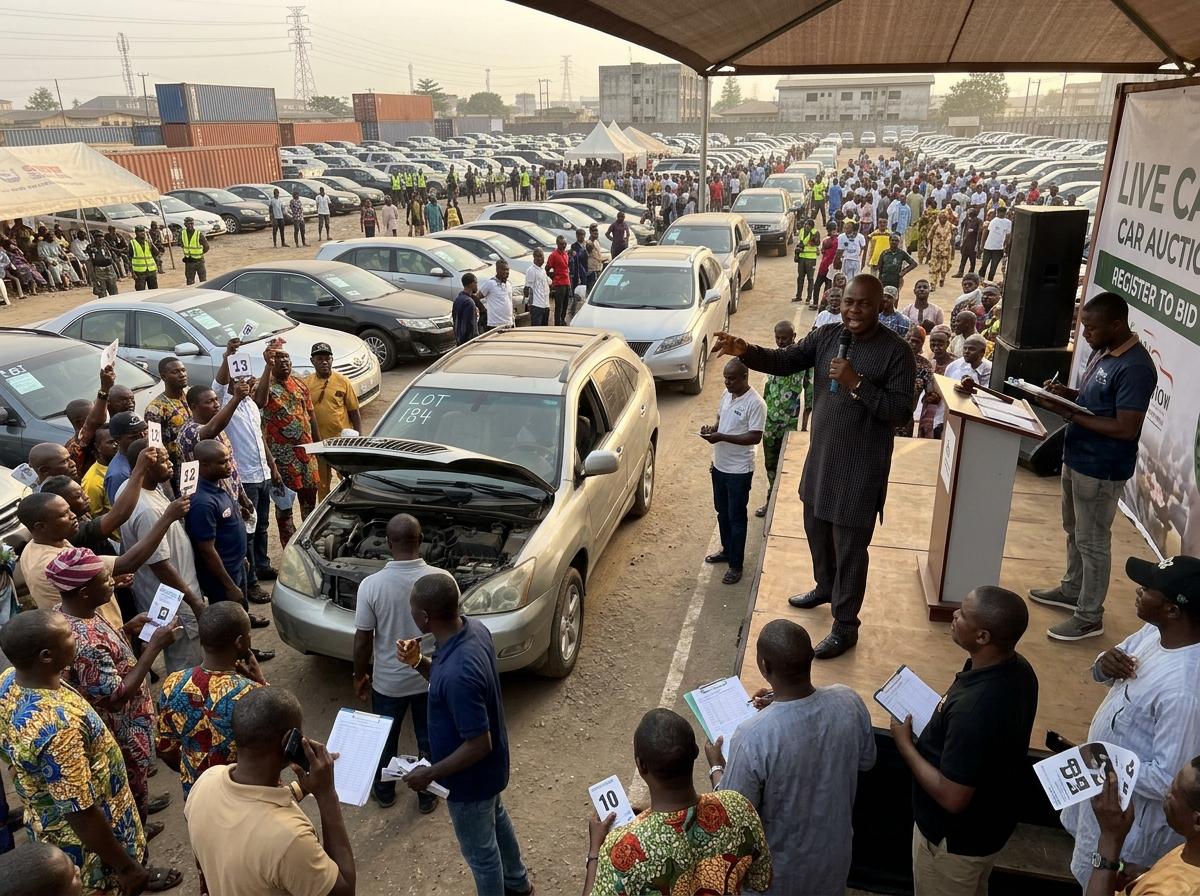
Demand certainly exists. When the Nigeria Customs Service relaunched its e-auction portal in January 2024, 13,605 people registered, and Customs raised more than ₦500 million from vehicle sales in under a month. Abroad, salvage cars at US auctions often sell for 30% to 60% of retail.
This guide explains how each type of car auction in Nigeria and abroad works, how to bid step by step, what the real costs look like, and how to avoid the common traps. You will also see how Afrikars lets you bid on US auction cars with the full landed cost in view. Read on and bid with confidence.
A car auction sells vehicles to the highest bidder instead of at a fixed price. Nigerian buyers meet four main types, and each one runs on different rules:
| Auction Type | Who Sells | Who Can Bid | Main Risk |
|---|---|---|---|
| Customs e-auction | Nigeria Customs Service sells seized or abandoned vehicles | Individuals with a valid TIN | Irregular sales, and unclear condition |
| Court-approved sales | Customs sells unclaimed cars after a court order | The public, by auction or allocation | Rare events, so rumours spread |
| US salvage and insurance auctions | Insurers sell total-loss and damaged cars on platforms such as Copart and IAAI | Dealers, public buyers, and brokers or import services | "As is" damage and title brands |
| US dealer auctions | Dealers and fleets trade cleaner cars, and rebuilt titles appear more often at places like Manheim | Mostly licensed dealers | Limited access for individuals |
| Bidding with Afrikars | US auction lots. The same kind of US lots, with landed cost shown | Everyone | Winning bids bind you |
The Nigeria Customs Service sells seized, abandoned, and overtime goods, including vehicles, through an online e-auction portal. Customs first moves the cars through a legal forfeiture process, then it lists them on the platform for bidding. Reports from the January 2024 relaunch show how it works:
- Register on the portal: Bidders register at auction.nigeriatradehub.gov.ng and agree to the terms.
- Hold a valid TIN: Only individuals with a valid Tax Identification Number, validated on the tax platform, can participate.
- Pay the participation fee: Each bid carried a ₦1,000 fee, and bidders could bid on up to two items per auction window.
- Follow the eligibility rules: Customs officers and the owners of seized items cannot bid.
- Pay through official channels only: Customs says all payments go through designated gateways or banks, and no facilitation fee helps you win.
- Claim your car with documents and ID: Winners must present the necessary documentation and identification.
The sales carry real volume when they run. Customs reported that 100 vehicles went on the portal after the relaunch and bidders won 86 of them.
Two cautions apply. First, Customs has said it does not auction seized vehicles frequently, because only certain categories qualify. Second, rumours travel fast. In an earlier clarification, Customs dismissed reports of a special auction of more than 7,000 cars. Rules, fees, and schedules change, so confirm every detail on the official portal and ignore anyone who offers a "special allocation" for cash.
Most Nigerian buyers who chase auction deals look abroad, because US platforms hold millions of cars. Copart and IAAI run wholesale auctions between insurers, who sell, and licensed buyers, with public access through guest accounts or brokers. Most Copart and IAAI lots carry a salvage-related title brand. Here is what to know before you bid.
- Access: Copart and IAAI limit bidding to licensed US dealers or registered public buyers. Public accounts face caps and lot restrictions, so many international buyers bid through a broker or an import service.
- Proxy bidding: You set a maximum bid in advance, and the system bids for you up to that limit. Pre-bid is called the default for international buyers, because of the time gap with US auction windows.
- Live bidding: You join the sale in real time and bid manually.
- Buy now: Some lots let you skip the bidding and pay a fixed price.
- Fees: Winning bids carry a tiered buyer fee, an internet bid fee, and other charges. Public-buyer internet fees of $59 to $69, and a buyer fee of 10% of the hammer price at $5,000 and above. A fee comparison finds Copart and IAAI fees within about 10% of each other on most lots.
- Payment deadlines: Copart advises international buyers to send funds early to avoid late payment fees of $50 per vehicle.
Auction cars sell "as is." The photos and condition report help, but they do not replace an inspection. Auction titles also matter. A car without a ready title can wait 35 to 45 days for one, and the auction may charge storage meanwhile. Read the title status on every lot before you bid.
Avoid these errors, and you already beat many first-time bidders:
- Chasing the lowest price: The cheapest lot often needs the biggest repair.
- Ignoring the title: A branded title can block registration or hurt resale.
- Skipping the VIN check: Records catch what photos hide.
- Forgetting fees: Fees stack up fast across every stage.
- Bidding without a limit: A missing limit invites overspending.
- Trusting unofficial offers: Anyone can claim to run an auction.
- Overlooking parts and mechanics: Rare models cost more to fix in Nigeria.
- Rushing the decision: Pressure serves the seller, not you.
Scammers copy the look of real sales. Therefore, test every offer against these warning signs:
- The organiser asks you to pay into a personal bank account.
- The prices sit far below the market with no clear reason.
- You receive the offer through unsolicited calls, emails, or social media messages.
- The seller skips registration, a TIN check, or any written terms.
- Someone pressures you to pay before you see the listing details.
- You cannot confirm the sale on the official Customs website or the platform's own site.
One red flag does not prove fraud. Still, resolve every concern before you send money.
At Afrikars, we help you use a US auction with the full price in view. You browse live auction lots, set your limit, and let our desk do the bidding. Here is what you get:
- Live lots with key details: Each lot shows the title status, damage level, drivability, key status, and pickup location.
- Landed price upfront: You see the vehicle, shipping, duty, and fees in one estimate, and the calculator itemises every line.
- Proxy bidding: You enter your maximum amount, and our bidding desk bids for you up to that limit.
- VIN Check: Run any VIN before you bid. Our VIN Check costs ₦8,500 per report, and verified customers receive 3 free checks at the point of purchase.
- Escrow protection: A licensed partner holds your funds and releases them in stages as each step clears.
- End-to-end handling: We act as importer of record, hold our own customs licence, clear your car, and pay the duties. You never deal with the port.
- Documents at delivery: You receive the title, the customs clearance papers, and proof of duty paid. Registration and plates come as an optional add-on.
- Live tracking: You follow your car in the app from the US port to your door.
A few honest notes apply. Auction cars sell “as is,” and winning bids bind you, so finish your title and VIN review before you set a limit. Afrikars also does not guarantee delivery times, so plan with a buffer.
Ready to start? Browse live auctions, estimate your total cost, or ask our Concierge team to source a specific model. You can also contact us with any question.
Yes. NCS periodically opens its e-auction portal and sells seized and overtime vehicles to the public. Sales do not run daily, so watch official channels for announcements. Some banks, firms, and dealers also run private sales. Verify every seller before you pay.
People with a valid TIN from FIRS can join. Customs officers and owners of the seized items cannot. At launch, sign-up cost ₦1,000, and each bid carried a ₦1,000 participation fee. Confirm the current fees on the official portal.
Yes. Copart and IAA both run online bidding that welcomes buyers outside the US. Registration asks for identification, and some lots limit bidding to licensed buyers. A proxy service solves that problem, since the desk bids on your behalf.
Proceed with care. Confirm the Nigerian import and registration rules, price the repairs, and add both to your landed cost. A cheap salvage lot sometimes costs more than a clean-title car once you finish the math.
No. Shipping, duty, clearing, and service fees all stack on top of the winning bid. A $2,250 lot, for example, showed an estimated landed cost near $7,936. Always compare the landed cost, not the bid.
Yes. You browse live US auction lots, see the estimated landed cost, and set your maximum bid. Our desk bids for you, a licensed partner holds your funds in escrow, and we handle shipping, customs clearance, and delivery.