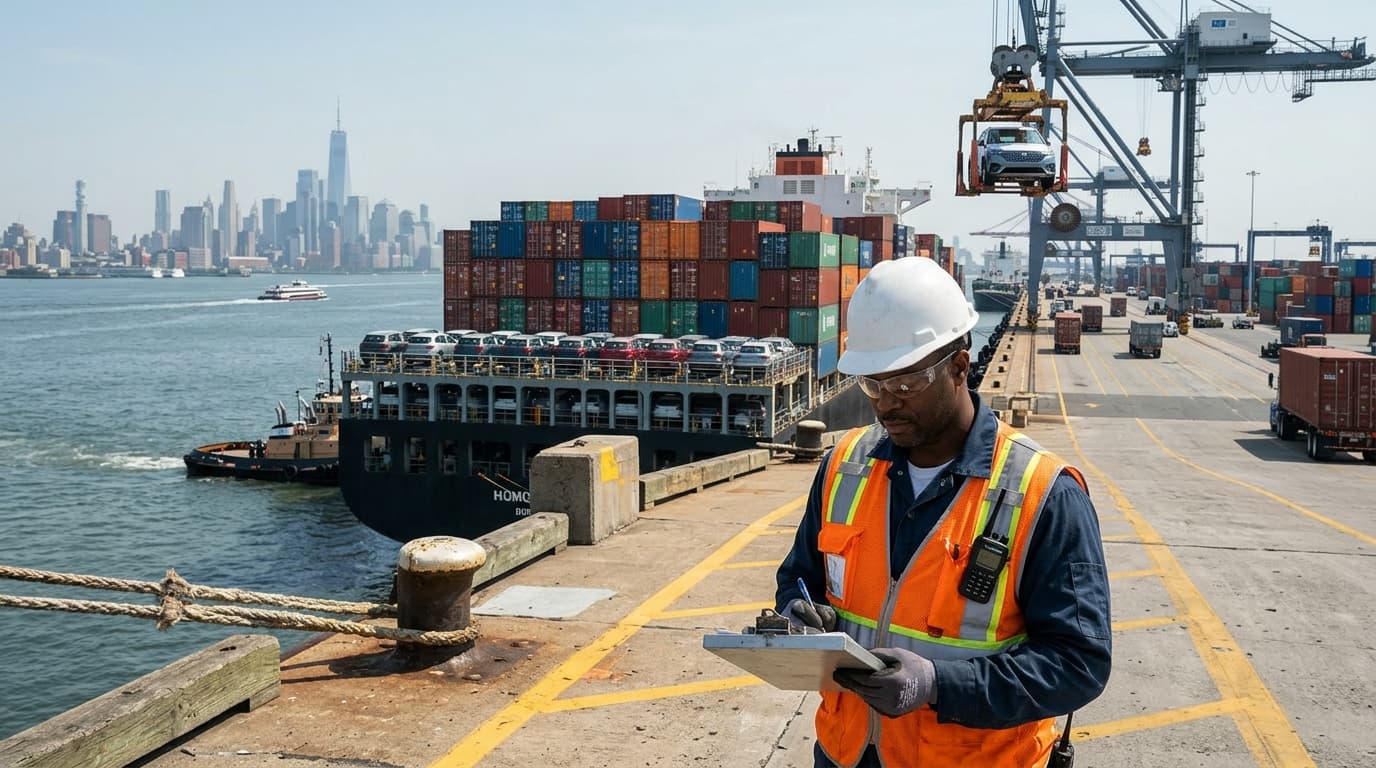
You found the perfect car in the US. The photos look great, and the price looks even better. Then the real questions start. How much does car shipping from USA to Nigeria cost? How long will your car sit at sea? Which papers does Customs want, and who clears the car at Apapa or Tin Can?
Many first-time importers guess these answers and pay for it later. Some miss a US export deadline and watch their car miss its vessel. Others forget Nigerian duty and levies, so the final bill shocks them. Meanwhile, demand keeps growing. Nigeria imported $602 million worth of motor vehicles and automotive parts from the United States between January and May 2026.
The good news: car shipping from USA to Nigeria follows a clear pattern once you know it. This guide breaks down shipping methods, current costs, timelines, documents, and Nigeria's 2026 rules. You will also see how AFRIKARS handles the whole journey, from purchase to your driveway. Read on, and plan your import with confidence.
Car shipping from USA to Nigeria runs in two halves. The US half covers purchase, title checks, inland transport, export filing, and loading. The Nigerian half covers Form M, customs assessment, duty payment, inspection, and release. Ocean freight links the two. A delay in one half slows the other, so you need a plan for both.
This list shows the journey at a glance:
- Buy the car and secure a clean title.
- Truck the car to a US port such as Houston, Newark, Savannah, or Baltimore.
- File export data and present the title to US Customs and Border Protection (CBP).
- Load the car and sail to Lagos.
- Open Form M and file the Nigerian customs declaration.
- Pay duty and levies, then pass inspection.
- Collect the car or arrange delivery.
Two methods dominate car shipping from USA to Nigeria. Roll-on/roll-off (RoRo) vessels let crews drive your car aboard and secure it on the car deck. Container shipping loads your car inside a steel box, which adds protection and lets you ship extra items with it.
| Factor | RoRo | Container |
|---|---|---|
| Cost | Usually the lowest | Higher |
| Protection | Secured on an open car deck | Sealed inside a steel box |
| Extra items | Usually the car only | Accessories and household goods can ride along |
| Non-running cars | Needs special handling | Usually the easier route |
| Best for | Standard running cars | Valuable cars and non-running cars |
RoRo costs roughly $500 to $2,000 per car, and the trip to Lagos usually takes about three weeks. Container shipping costs more, but it adds protection. Shared container adds about a week to the sailing time. Non-running vehicles usually travel by container, or by RoRo with special handling.
Use these rules to choose:
- Pick RoRo when your car runs and you want the lowest freight bill.
- Pick a container when your car has high value, needs extra protection, or does not run.
- Pick a shared container when you want container protection at a lower price and can wait an extra week.
Freight quotes vary widely, because each carrier prices by method, vehicle size, and departure port. Naira figures use ₦1,376 to US$1, the rate AFRIKARS currently displays on its site.. Rates shift with fuel prices, vessel space, and season. Always request a written quote before you commit.
Several factors push your quote up or down:
- Vehicle size: An SUV or pickup takes more deck space than a compact sedan.
- Departure port: Houston, Newark, and Savannah price differently.
- Shipping method: Containers cost more than RoRo.
- Inland transport: A car in Texas travels a shorter distance to Houston than a car in Ohio.
- Insurance: Marine cover adds a small percentage of the car's value.
For a real reference, the AFRIKARS cost calculator shows $1,800 for shipping a 2021 Toyota Camry SE from Houston to Lagos. That equals roughly ₦2.48 million at today's displayed rate.
Freight forms only one slice of your bill. Duty, taxes, levies, and fees often cost more than the ocean leg. Here is a sample breakdown from our calculator for a 2021 Toyota Camry SE, using ₦1,450 to US$1 for illustration:
| Cost Line | Amount (USD) |
|---|---|
| Vehicle price | $14,500 |
| Shipping, Houston to Lagos | $1,800 |
| Import duty | $3,260 |
| NAC levy | $815 |
| Green Tax (engine above 2,000cc) | $326 |
| Customs surcharge | $228 |
| VAT | $1,600 |
| Customs operations charge | $652 |
| ETLS levy | $82 |
| AFRIKARS service fee | $1,500 |
| Total landed cost | $24,763 (about ₦35.9 million) |
Notice the pattern. Shipping covers only about 7% of the total, while duty, taxes, and levies add up to $6,963, or roughly 28%. Many buyers focus on freight and overlook this larger slice.
Rules also shift quickly. Duty on used vehicles fell from 20%, 15%, and 10% to 5% after 1 July 2026, while a new Green Tax now hits engines of 2,000cc and above. Dealers have warned that prices may not drop right away. Check the latest rates with Customs or a licensed agent before you budget.
The ocean voyage takes only part of the time. Paperwork, inland transport, and clearance also add days. This table shows each stage:
| Stage | Typical Time |
|---|---|
| Purchase, title, and payment | Several days to a week |
| Inland transport to the US port | A few days |
| CBP document check and export filing | At least 72 hours before export |
| Ocean sailing to Lagos | About 3 to 7 weeks, depending on method and schedule |
| Nigerian clearance and release | Varies with paperwork and port traffic |
Published estimates match this range. One guide puts the whole process at 4 to 6 weeks. Another puts the transit to Lagos at 4 to 7 weeks. On our platform, cars have arrived in about six weeks on average from the point of purchase, covering sourcing, shipping, and clearing. AFRIKARS does not guarantee a delivery time, so your own timeline may differ.
Several factors stretch the schedule:
- Vessel schedules: Sailings leave on fixed dates, so a missed cut-off costs you a week or more.
- Weekends and holidays: The 72-hour CBP window excludes weekends and federal holidays.
- Port traffic: Congestion at Apapa or Tin Can slows release.
- Paperwork errors: A mismatched VIN or missing document stops the file cold.
Choose a car that fits your budget and your roads. Then run the VIN through a history report, and read the title status closely. Auction cars sell "as is," so study the condition report before you bid. Our VIN Check gives you a quick start.
CBP checks the title, any lien release, the seller and buyer names, and the declared value on every vehicle that leaves the country. Gather the original title, a bill of sale, and a lien release if a lender financed the car. Make sure every name and number matches. Never understate the car's value. In June 2026, CBP seized five cars at the Port of Tampa after bills of sale declared far less than their market value.
Book inland transport from the seller to your departure port. Photograph the car at pickup, because those photos protect you if damage claims arise later.
Every self-propelled vehicle needs Electronic Export Information (EEI) through the Automated Export System, regardless of value, and the filing produces an Internal Transaction Number (ITN). Federal rules require the ITN to reach the carrier at least 72 hours before a used vehicle exports. Miss that window, and you may face denied loading and storage fees. Confirm in writing who files, whether you, your freight forwarder, or your import service.
Your carrier issues a Bill of Lading once the car loads. This document records the shipper, consignee, cargo, and route, so keep a copy. Add marine insurance if you want cover during the voyage.
Start early. You need a Form M, a Pre-Arrival Assessment Report (PAAR) through Customs' B'odogwu platform, and often a SONCAP certificate for vehicle standards. The official trade portal also notes that you need a licensed customs agent for clearance processing.
Apapa and Tin Can Island in Lagos handle most vehicle imports. Your agent files the goods declaration, pays duty and levies, and presents the car for physical inspection. Customs then releases the car, and you arrange delivery.
Inspect the car on arrival and compare it with your pickup photos. Then buy motor insurance, and register the car with your title and customs papers.
On the US side:
- Original vehicle title (plus a lien release for financed cars)
- Bill of sale showing the true price
- EEI filing and ITN
- Shipping booking and Bill of Lading
On the Nigerian side:
- Form M
- Pre-Arrival Assessment Report
- Commercial invoice and Combined Certificate of Value and Origin
- SONCAP certificate
- Marine insurance certificate
- Customs declaration and proof of duty payment
Requirements change, so confirm the exact list with Nigeria Customs and your agent before the car sails.
Check these rules first, because they decide whether your car can enter at all:
- Age limit: The official trade portal says vehicles must stay under 15 years from manufacture. Meanwhile, Legit.ng reports that the Customs prohibition list bars used cars older than 12 years. Pick a newer car and confirm the current limit before you buy.
- Green Tax: Engines of 2,000cc and above face the surcharge, while smaller engines stay exempt.
- NAC levy: This levy applies on top of customs duties.
- Valuation: Customs decides the value for duty, so your invoice alone does not set the bill.
- Skipping the landed cost: Buyers compare US prices and forget duty, levies, and fees.
- Missing the 72-hour window: Late filings delay loading and add storage charges.
- Ignoring the age limit: An overage car cannot clear.
- Mismatching documents: A wrong VIN or name on the title stalls everything.
- Buying auction cars blind: "As is" means you accept the condition.
- Leaving clearing to chance: Without a licensed agent, you risk delays at the port.
- Compare three quotes: Rates differ between carriers and ports.
- Choose RoRo for running cars: It usually costs the least.
- Buy near your departure port: Shorter inland trips cut costs.
- Pick a smaller engine: Cars under 2,000cc avoid the Green Tax.
- Calculate the total first: A cheap car with expensive shipping can lose to a pricier car nearby.
- Book early: Early booking helps you catch the right vessel and avoid storage fees.
AFRIKARS runs car shipping from USA to Nigeria as one connected chain. You choose a car from dealer stock or auction lots, review what we know about it, and fund a budget. Then we buy the car on your behalf and move it through every stage.
Here is what that gives you:
- Landed price upfront: Each listing shows an estimated landed cost, so you see the car, shipping, and duty in one figure before you commit.
- Escrow protection: A licensed partner holds your funds and releases them in stages as each step clears.
- Importer of record: We hold our own customs license, clear your car, and pay the duties, so you never deal with the port or a separate agent.
- Live tracking: You follow your car in the app, from the US port to your driveway.
- Damage evidence: We photograph your car at pickup and again at the port. If it arrives damaged, we take it up with the carrier for you. Marine insurance stays optional, and you add it to your quote.
- Documents at delivery: You receive the title, the customs clearance papers, and proof of duty paid. Registration and plates come as an optional add-on.
A few honest notes help you plan. AFRIKARS does not guarantee delivery times. Government regulation can also raise a landed cost, though that happens rarely. Auction cars sell "as is," so you accept their condition once you authorise the purchase.
Ready to start? Run your numbers on the cost calculator, check any car with the VIN Check, or ask our Concierge team to source a specific make and model. You can also contact us with any question.
Published freight quotes range from about $500 to $6,500, depending on method, vehicle size, and port. RoRo costs the least, and containers cost more. Remember that duty, levies, and fees add to your total, so calculate the full landed cost before you buy.
The sailing usually takes 3 to 7 weeks, and the full process often runs 4 to 6 weeks. On our platform, cars have arrived in about six weeks on average from purchase. Treat that figure as an average, not a promise.
Choose RoRo when your car runs and you want the lowest price. Choose a container when your car has high value, needs extra protection, or does not run. A shared container sits in between on price but adds about a week.
You need the original title, a bill of sale, an EEI filing, and a Bill of Lading on the US side. In Nigeria, expect Form M, a PAAR, a SONCAP certificate, an insurance certificate, and a customs declaration. AFRIKARS customers receive the title, customs clearance papers, and proof of duty paid at delivery.
Yes. The official trade portal states that you need a licensed customs agent for clearance processing. AFRIKARS acts as importer of record and holds its own customs license, so we clear your car for you.
Often yes. Shippers usually handle non-running cars by container, or by RoRo with special handling. Expect a higher price, and tell the shipper about the condition upfront.
Yes. We buy the car, move it to the port, file the export paperwork, ship it, clear it through Nigerian customs, and deliver it. You track each stage in the app, and your money stays in escrow until each step clears.