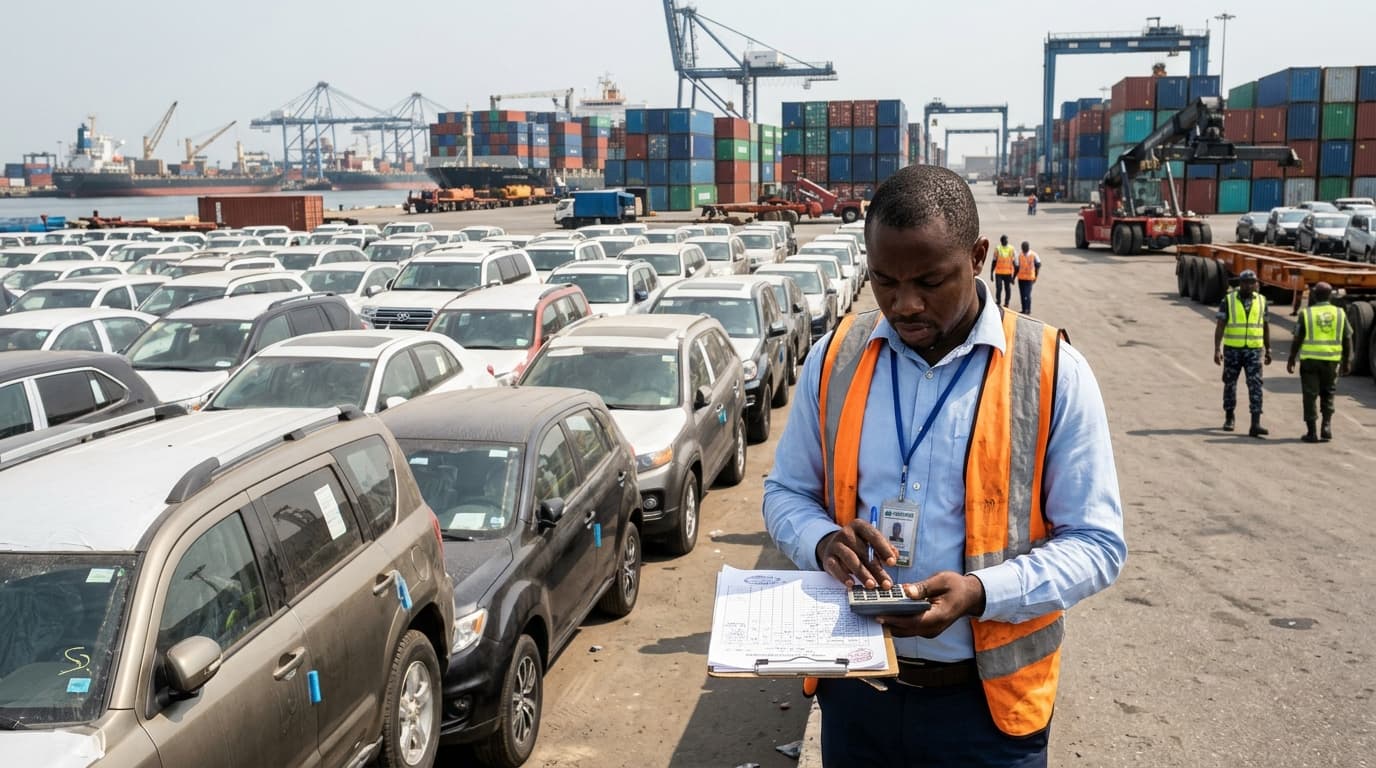
A cheap car abroad doesn't always mean a cheap car in Nigeria. When researching the cost of clearing a car in Nigeria, you need to look beyond the price displayed by a dealer or auction platform. A vehicle that initially appears affordable may require additional spending on shipping, customs duties, applicable taxes, port charges, and delivery. If you overlook these expenses, you could end up spending more than you planned or choosing a vehicle that no longer fits your budget.
That's why calculating the total landed cost matters before you purchase an imported car. Nigeria's customs valuation framework sets out how customs determines the value of imported goods and how the applicable tariff rules affect duty assessments. The Nigeria Customs Service also publishes tariff information and updates, so relying on outdated rates or assumptions can lead to inaccurate estimates.
To help you make a more informed decision, this guide explains the cost of clearing a car in Nigeria and the expenses you should consider before importing one. You'll learn how customs duties and other charges work, what determines your final clearance bill, and how to check duty status. We'll also show you how AFRIKARS helps buyers review itemised estimates covering the vehicle, shipping, customs duties, and other included charges before committing to a purchase.
The cost of clearing a car in Nigeria involves specific statutory duties, levies, and port-clearing charges managed by the Nigeria Customs Service (NCS) under the ECOWAS Common External Tariff (CET) framework.
Here are the main charges to understand before importing a car:
- Import Duty: 20% of the CIF (Cost, Insurance, and Freight) value for passenger vehicles (HS Code 8703).
- National Automotive Council (NAC) Levy:
- 5% of CIF for used (Tokunbo) vehicles (reduced from 15%).
- 10% of CIF for brand-new vehicles (reduced from 20%).
- Green Tax Surcharge: Based on engine capacity (cc):
- Below 2,000cc: Exempt (0%)
- 2,000cc–3,999cc: 2% of CIF
- 4,000cc and above: 4% of CIF
- Surcharge: 7% applied specifically on the Import Duty amount (not the CIF).
- ECOWAS Trade Liberalisation Scheme (ETLS): 0.5% of CIF.
- CISS / FOB Levy: 1% CISS or 4% FOB (depending on enforcement and current valuation rules).
- Value Added Tax (VAT): 7.5% calculated on the cumulative stacked total (CIF + Import Duty + NAC Levy + Green Tax + other stacked fees).
- Exemptions: Electric vehicles (EVs) and mass-transit buses are exempt from import levies and the Green Tax.
Beyond federal taxes, physical clearing at Nigerian ports (such as Tin Can or Apapa in Lagos) incurs local terminal, agent, and logistics expenses:
- Terminal Handling Charges: ~₦450,000
- Clearing Agent Fees: ~₦700,000
- Inland Vehicle Delivery / Haulage: ~₦250,000
- Total Estimated Operational/Clearing Costs: ~₦1,400,000 or higher depending on the terminal and agent.
- Note on Valuation: The Nigeria Customs Service often assesses vehicle value 20% to 50% above the actual purchase invoice using its internal valuation database. Currency conversion relies on the official Central Bank of Nigeria (CBN) exchange rate at the time of assessment.
The cost of clearing a car in Nigeria typically ranges from ₦2.5 million to over ₦10 million, depending on the vehicle type, engine size, model year, and the automated VIN valuation system used by the Nigeria Customs Service.
Below are the current clearing cost estimates by vehicle category:
- Small Sedans & Regular Cars (e.g., Toyota Corolla, Honda Civic): ₦2.5 million–₦2.8 million
- Standard SUVs (e.g., Toyota RAV4, mid-size SUVs): ₦2.8 million–₦4.5 million+
- Large SUVs & Luxury Vehicles (e.g., Toyota Land Cruiser, Mercedes GLE): ₦5 million–₦10 million+ (influenced by the new Green Tax on larger engines)
The cost of clearing a car in Nigeria is calculated using the vehicle's Cost, Insurance, and Freight (CIF) value, determined automatically via the Nigeria Customs Service (NCS) VIN Valuation System, plus statutory import duties, levies, taxes, and local port/terminal charges.
Follow these steps to estimate your expenses.
Customs valuation follows the applicable valuation rules and may take account of the transaction value and relevant costs associated with importing the vehicle. Keep your purchase invoice and shipping documents available, but remember that the price you paid does not automatically determine the final customs assessment.
Check the tariff classification and applicable rates for the specific vehicle. Depending on the current regulations, your assessment may include:
- Import duty and applicable levies.
- VAT and other applicable taxes.
- The Green Tax Surcharge, where relevant.
- Other charges required under the current fiscal policy.
Your budget should also include shipping, port handling, terminal charges, service fees, and inland transportation where applicable. These expenses can significantly affect the overall cost, even when you purchase the vehicle at an attractive price.
The total landed cost is the combined amount you expect to spend to purchase and bring the vehicle to your destination.
For example, suppose you purchase a car from the United States for $5,000 and pay $1,000 for shipping. Your preliminary vehicle-and-shipping subtotal is $6,000.
You must then add the applicable customs duties, taxes, port charges, service fees, and other relevant expenses to estimate the total landed cost.
Calculating every expense manually can be challenging, especially when comparing vehicles from different sellers or auction platforms. AFRIKARS helps simplify the process by providing itemised estimates for vehicle prices, shipping, customs duties, and other charges. You can use our landed cost calculator to review the estimated landed cost before committing to a purchase and make a more informed decision based on your budget.
Visit AFRIKARS to explore available vehicles and estimate your import expenses.
The cost of clearing a car in Nigeria depends on government tax policies, vehicle type, port fees, and currency exchange rates. Understanding these factors before purchasing a vehicle can help you prepare a realistic budget and avoid unexpected expenses.
Here are more details on the major factors that influence car clearing costs in Nigeria:
- Vehicle Import Levies: Under current fiscal policies, brand-new vehicles carry a 10% import levy, while foreign-used (Tokunbo) vehicles carry a 5% import levy.
- Electric Vehicles (EVs): Electric vehicles carry a 0% import duty.
- Green Tax Surcharge: A Green Tax applies to larger-engine vehicles and heavy SUVs (such as Land Cruisers, Prados, and large Mercedes models), while regular small cars (like the Toyota Corolla or Honda Civic) are exempt.
- Value Added Tax (VAT) & Surcharges: Standard federal charges include a 7.5% VAT, a 7% Port Development Levy, and a 0.5% ECOWAS Trade Levy (ETL).
- Vehicle Identification Number (VIN) Valuation: The Nigeria Customs Service assesses cars using automated VIN valuation tied to the vehicle's make, model, and year rather than just the purchase invoice.
- Customs Exchange Rate: Customs duties are calculated in Naira using the official Central Bank of Nigeria (CBN) / Customs exchange rate at the time of assessment (floating around ₦1,350 to ₦1,383+ per USD), which means fluctuations directly alter the final clearing bill.
- **Nigerian Ports Authority (NPA) Charges**: Fees are billed when the vessel enters the port, scaled according to the vehicle's cubic volume (CBM) category.
- Terminal Handling Fees: The specific terminal operator charges for moving, positioning, and handling the vehicle within the yard.
- Shipping Line/Agent Fees: Separate fees are billed by the shipping line or its local agent to authorize cargo release.
- Free Period Limits: Vehicles typically get a short window (e.g., 3 free days post-discharge) before daily storage or rent kicks in.
- Escalating Daily Rates: If clearance stalls, rent increases based on vehicle size (ranging from lower daily fees initially to higher stepped-up rates if left uncleared).
- SON and Agency Fees: Mandatory documentation includes certification from the Standard Organisation of Nigeria (SON), plus potential re-testing costs if safety equipment or standards fail, alongside standard customs processing forms.
- Age Limits and Modifications: Vehicles older than certain thresholds or heavily modified units can trigger stricter inspection or higher compliance overhead.
- Freight and Shipping: The cost to ship the car via RoRo (Roll-on/Roll-off) or container from the origin country.
- Clearing Agent Professional Fees: Service charges paid to licensed freight forwarders/agents to manage documentation and physical inspections.
- Inland Transportation: Cost to drive or tow the vehicle from the port to its final destination.
You can verify whether a car has valid customs clearance using official online portals without needing middlemen:
- Customs Verification Management System (CVMS):
- Visit the Customs Verification Management System.
- Input the car's 17-character Vehicle Identification Number (VIN) or Chassis Number.
- Pay the verification fee (around ₦15,000) using a debit or credit card.
- View and download the official digital Customs Verification Receipt, which includes a QR code for validation.
- Vehicle Registration System (VREG):
- Register an account as an individual, company, or agent on the VREG Portal.
- Add the car's VIN to check its comprehensive vehicle history, import duty status, and compliance.
If you are importing a car into Nigeria, customs duty is handled as part of the import clearance process. The applicable amount depends on the vehicle's customs value, tariff classification, and the current duty and tax rules.
To prepare for payment:
- Engage a Licensed Customs Clearing Agent: Direct payment of car import duty into the NCS system generally requires processing through a licensed clearing agent and the NICIS (Nigeria Integrated Customs Information System) platform at the port of entry (such as Apapa, Tincan, or PTML).
- Assessment & Assessment Notice: The agent inputs the car's VIN into the system to generate an official assessment (Demand Notice/Bank Reference Number).
- Bank Payment: Pay the assessed amount through designated commercial banks linked to the Nigeria Customs Service single-window/Remita payment channels.
- Obtain Proof of Payment: Once paid, ensure you receive the official Customs Duty Certificate and signed entry documents, which are required for subsequent Vehicle Inspection Service (VIS) registration and getting a number plate.
Calculating the total cost of clearing a car in Nigeria can be challenging when you have to account for the vehicle's purchase price, shipping, customs duties, and other expenses separately.
AFRIKARS helps simplify this process by providing estimated landed costs for vehicles sourced from the United States. Instead of focusing only on the advertised price or winning auction bid, you can review an estimate of the costs involved in bringing the vehicle to your destination.
Here's how AFRIKARS can help you plan your car purchase.
Visit AFRIKARS to explore available vehicles and compare different makes, models, years, and prices. You can assess the available options based on your preferences and budget before deciding which vehicle to pursue.
AFRIKARS displays an estimated landed cost for its listed vehicles. This helps you understand the potential cost of importing a car rather than relying solely on its overseas purchase price.
The estimate can include:
- The vehicle's purchase price.
- Shipping costs.
- Estimated customs duties and applicable charges.
- AFRIKARS' service fee.
- Other costs included in the displayed landed-cost estimate.
A vehicle with a lower purchase price may not necessarily have the lowest total landed cost. Shipping expenses, customs charges, condition, and potential repairs can make a significant difference. By comparing the estimated landed costs of different vehicles on AFRIKARS, you can make a more informed decision about which option best fits your budget.
AFRIKARS offers an end-to-end service for eligible vehicle purchases, including buying on your behalf, coordinating shipping, handling customs clearance, and arranging delivery. AFRIKARS stated service also includes secure escrow arrangements and vehicle checks. This can be useful if you want to import a car from the United States but are unfamiliar with auction procedures, international shipping, or Nigerian customs clearance.
Although AFRIKARS provides an estimated landed cost before you commit, the final amount is not guaranteed to remain unchanged. Government regulations, customs assessments, and other external factors may affect the total.
Before completing your purchase, review the displayed cost breakdown and confirm any charges that require clarification.
Ready to estimate your car import costs?
Visit AFRIKARS to explore available vehicles, compare estimated landed costs, and plan your budget before making a purchase. By considering the full cost of importing and clearing a car in Nigeria, you can make a more informed decision and reduce the risk of unexpected expenses.
The cost depends on the vehicle's customs value, tariff classification, applicable duties and taxes, and other clearance expenses.
No. Customs duty is a government charge assessed on imported goods, while total clearing expenses may also include applicable taxes, levies, port charges, and clearing-agent fees.
You can use the government's Vehicle Registration System (VREG) to access vehicle verification services. You should also review the vehicle's customs clearance documents before purchasing it.
Yes. You can estimate the vehicle price, shipping, customs charges, and other expenses before purchasing. AFRIKARS provides estimated landed costs to help you plan your budget, although the final amount may change following customs assessment.
Yes. AFRIKARS offers an import service for eligible vehicle purchases, including coordinating vehicle purchases, shipping, customs clearance, and delivery. You can explore available vehicles and review their estimated landed costs on the AFRIKARS website.