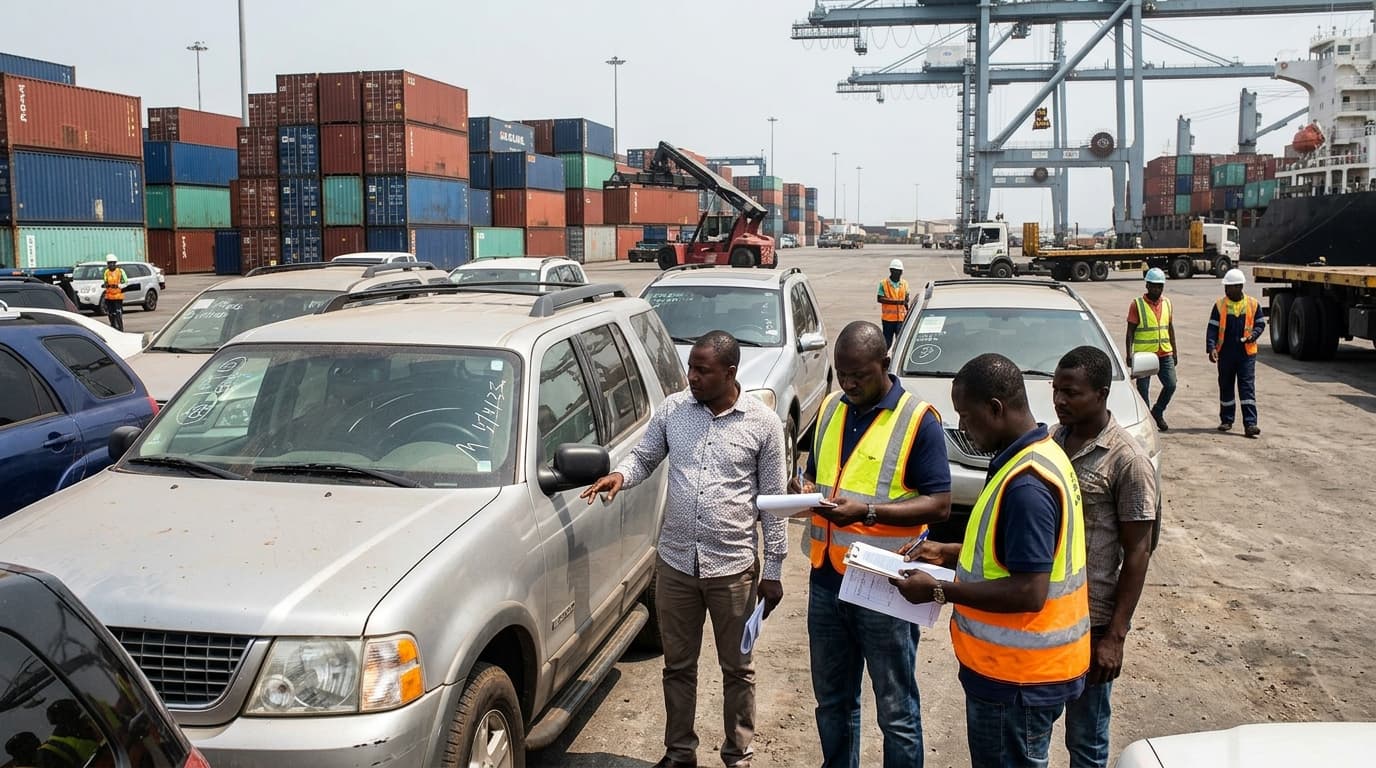
Buying used cars from the USA can look like a smart way to access better vehicle options, competitive prices, and vehicles with verifiable histories. But there is a costly mistake many African buyers make: focusing only on the advertised vehicle price and ignoring what happens after the purchase. According to recent data, Nigeria imported $602 million worth of motor vehicles and automotive parts from the United States in just the first five months of 2026.
So, what happens when the car you find for $8,000 eventually costs much more to get onto African roads? Shipping, inland transportation, customs duties, taxes, clearing charges, documentation, and unexpected vehicle problems can quickly turn an attractive deal into an expensive mistake. The U.S. Department of Commerce also identifies Nigeria as heavily dependent on vehicle imports and notes that used imported vehicles remain critical to meeting local demand.
This is where having the right information before you buy matters. AFRIKARS allows buyers to explore vehicles from the U.S., review vehicle information and history, and see indicative landed-cost estimates for listed vehicles. In this guide, you'll learn how to buy used cars from the USA and import them to Africa, including how to find the right vehicle, verify its history, estimate the total cost, handle shipping and customs, and avoid common mistakes that can wipe out your savings.
It can be, particularly when you find a vehicle that offers the right combination of price, condition, specifications, and availability. But don't chase the lowest auction price. Chase the best overall value. A slightly more expensive vehicle with a clean history, better condition, and predictable import costs can ultimately save you more money than a heavily damaged vehicle that looks cheap at auction.
Finding used cars from the USA for sale is relatively easy. However, finding one that matches your budget, condition requirements, and intended use requires more care. Below are some sources you can explore:
If you want to source a vehicle from the United States and have the process organized around the Nigerian market, AFRIKARS is one option worth exploring first. AFRIKARS provides access to U.S. vehicle sourcing and auction-related services and is designed to help you navigate the process of purchasing and importing vehicles. You can use it to explore available vehicles while considering the broader costs involved in getting the car to Nigeria.
U.S. auctions can give you access to thousands of vehicles, including cars that may be sold below conventional retail prices. However, many auction vehicles may have damage, salvage titles, or other issues. If you are considering an auction vehicle, pay close attention to:
- Auction condition description
- Damage type
- Title status
- Vehicle photos
- Mileage
- VIN
- Location
- Estimated repair requirements
Kindly note that a low auction price does not automatically mean you have found a bargain.
You can also find used cars through American dealerships and online vehicle marketplaces. These may offer vehicles with different ownership, inspection, and warranty arrangements. Before paying, verify that the seller is legitimate and confirm exactly what is included in the advertised price.
If you are searching for used cars from the USA, you may have already discovered that the American market gives you access to thousands of vehicles. The bigger question is: how do you find the right car, know its real cost, and get it to Africa without turning the process into a headache?
With AFRIKARS, the process is designed to bring several parts of the transaction into one platform. You can browse U.S. dealer inventory, explore auction vehicles, review available vehicle information, see an estimated landed cost, and follow the car's journey after purchase.
Here is how the process works.
Start by deciding what you actually need. You can search by make, model, body type, price range, and other vehicle details rather than simply choosing the cheapest car available.
For example, you might search for:
- Toyota Camry
- Toyota Corolla
- Honda Accord
- Toyota RAV4
- Honda CR-V
- Lexus RX
- Toyota Highlander
- Mercedes-Benz models
- Pickup trucks and other utility vehicles
AFRIKARS currently offers two main ways to discover vehicles: dealer marketplace inventory and U.S. auction vehicles.
This is where you should slow down. For marketplace vehicles, AFRIKARS says you can review the listing photos, dealer walkthrough video, and vehicle history report before authorizing the purchase. Its team checks these materials before the vehicle is offered through the marketplace.
For auction vehicles, the process is different. Auction cars are sold “as is,” so you should carefully review the auction's photos and condition report, and run the available VIN check before you authorize a purchase. A low-priced auction vehicle may look attractive, but the condition can make a huge difference to your final cost.
Don't rely on the vehicle's photographs alone. A VIN check can help you investigate the specific vehicle before you commit your money. At AFRIKARS, we currently offer a free VIN check. You should use the available information to answer questions such as:
Does the VIN match the vehicle? Is the mileage consistent? What does the title say? Has the vehicle suffered reported damage? Does the condition shown in the listing make sense based on its history?
The more information you have before purchasing, the lower your chances of being surprised later.
This is one of the most important parts of the AFRIKARS process. Instead of looking only at the U.S. vehicle price, AFRIKARS has a landed cost calculator that displays an estimated landed cost that takes the vehicle, shipping, customs, and related charges into consideration. At AFRIKARS, the full cost is shown before you commit.
For example, a vehicle might have a U.S. price of $15,000 but a significantly higher landed price once shipping, duties, customs charges, and other applicable costs are included.
That means you can compare U.S. vehicle price against total estimated cost to get the vehicle to you. This is a much better way to judge whether you are actually getting a good deal.
Once you find a vehicle you want, you fund your purchase budget through AFRIKARS. At AFRIKARS, funds are held in escrow by a licensed partner and released in stages as the relevant purchase steps are confirmed. You can fund your purchase in naira or U.S. dollars, with the applicable amount and exchange rate shown during the process. This means you should know your maximum comfortable budget before you start bidding or authorizing a purchase.
After reviewing the vehicle and deciding that the numbers work for you, you authorize AFRIKARS to purchase it on your behalf. For auction vehicles, AFRIKARS provides a proxy-bidding option. You enter your maximum amount, and its bidding desk can bid on your behalf up to the amount you authorize.
This is particularly useful if you don't want to navigate the U.S. auction process yourself. Remember, however, that an auction purchase is a serious commitment. At AFRIKARS, winning auction bids are binding. So you should complete your vehicle and history checks before setting your maximum bid.
After purchase, the vehicle needs to get from its U.S. location to the shipping port before crossing the Atlantic. At, AFRIKARS, our process covers inland transportation, export clearance and ocean freight as part of our shipping chain. You can also track the vehicle's progress through the platform. Meanwhile, the exact journey depends on where the vehicle is located and the shipping arrangements involved.
Once the vehicle arrives in Nigeria, customs clearance becomes another important part of the process. AFRIKARS currently acts as the importer of record, handles customs clearance, and pays the applicable duties on your behalf. Therefore, you do not need to independently hire a clearing agent for a purchase made through our end-to-end service. This can simplify the process considerably because you don't have to coordinate multiple unrelated parties yourself.
At AFRIKARS, you don't simply pay and wait. You can track the vehicle's journey through the app, with stages covering the movement from purchase through shipping and delivery. Furthermore, through the app, customers can receive photos and videos at different stages of the vehicle's journey. This gives you visibility into where your vehicle is instead of leaving you dependent on occasional updates from different logistics providers.
After customs clearance, AFRIKARS will deliver the vehicle to your specified destination. As a customer, you'll receive the vehicle's title, customs clearance documents, and proof of duty paid. Meanwhile, registration and number plates are available as an optional service; otherwise, you can handle registration yourself using the documents provided.
Before you authorize the purchase of any of the used cars from the USA you find online, take a few minutes to investigate the vehicle. A cheap car is only a good deal when its condition, history, and total landed cost make sense.
You can use this checklist:
- VIN: Confirm the vehicle identity and run the available history checks.
- Title: Understand whether the title is clean, salvage, or another classification.
- Mileage: Compare the displayed mileage with available history.
- Damage: Don't ignore accident or damage descriptions simply because the repair appears affordable.
- Photos: Look closely for structural, body, and interior damage.
- Mechanical condition: Consider the engine, transmission, suspension, and other major components.
- Parts availability: Can you easily find replacement parts in your country?
- Fuel economy: Will the engine be economical for your daily use?
- Maintenance: Can local mechanics work on it?
- Landed cost: Check shipping, customs, clearing, and service costs before committing.
- Resale value: Is there sufficient demand for the model locally?
- Repair budget: If the vehicle needs repairs, include those expenses in your calculation.
- Maximum budget: For an auction, decide your maximum bid before the bidding starts.
The cost of importing used cars from the USA to Africa depends on several factors, so there is no single price that applies to every vehicle or every African country.
The biggest mistake you can make is to look at the U.S. purchase price and assume that is what the car will eventually cost you.
Your total cost can look more like this:
Vehicle price, purchase fees, U.S. transportation, shipping, insurance, customs/import charges, port fees, clearing, local delivery = estimated landed cost. AFRIKARS can be useful when you want to explore U.S. vehicle sourcing while considering the logistics involved in bringing the vehicle to Nigeria. You can make use of our landed cost calculator here.
If you are considering used cars from the USA, you may be wondering which models are actually worth importing. A vehicle can look like a great deal in the United States and become a poor investment after shipping, customs, repairs, and maintenance are added.
For Nigeria and many other African markets, you should look beyond the purchase price. Consider reliability, spare-parts availability, fuel consumption, ground clearance, maintenance costs, resale value, and the vehicle's condition.
Popular options include:
Typically, these are not automatically the best choices for everyone. Your driving needs should determine what you import. For example, if you mainly drive around a city, a Corolla may make more financial sense than a large SUV. If you regularly travel on rough roads or carry several passengers, an SUV may be more appropriate.
The exact documents you need to import used cars from the USA to Africa depend on the country where you want to clear the vehicle. Nigeria, Ghana, Kenya, South Africa, and other African countries have different customs and import procedures.
If you are importing into Nigeria, you should expect documentation around the vehicle purchase, shipping, customs declaration, and clearance.
Common documents can include:
- Vehicle title: Proof of ownership from the U.S. side.
- Commercial or purchase invoice: Evidence of the vehicle's purchase price and transaction.
- Bill of Lading: Shipping document identifying the vehicle and its transportation details.
- Proforma invoice: Used in the import documentation process where applicable.
- Insurance certificate: Required where applicable for the import transaction.
- Customs declaration documents: Documents required to process the vehicle through Nigerian Customs.
- Form M: Applicable import documentation for qualifying transactions.
- Combined Certificate of Value and Origin (CCVO): Used in Nigeria's import documentation process.
- VIN/chassis information: Important for vehicle identification and customs valuation.
- Relevant port and terminal documents: These support clearance and release of the vehicle.
If you have just purchased one of the used cars from the USA, waiting for it to arrive can feel like the longest part of the process. But shipping time and total delivery time are not necessarily the same thing. For a U.S.-to-Nigeria shipment, ocean transit can take roughly three to six weeks, depending on the U.S. departure port, destination, shipping method, and sailing schedule. Current shipping references put some U.S. East Coast-to-Lagos RoRo routes at around 21–28 days, while other routes and shipping methods can take longer.
After the vessel arrives, you still need to account for:
- Port berthing and discharge
- Customs documentation
- Customs valuation
- Inspection
- Duty and tax payments
- Terminal procedures
- Vehicle release
- Inland transportation
Customs clearance can therefore add days or weeks depending on the circumstances.
Several factors can extend the timeline:
- Vehicle location in the USA: A vehicle located far from the shipping port may require additional inland transportation time.
- Shipping schedule: You may have to wait for the next available vessel.
- Documentation problems: Missing or incorrect documents can delay export or customs clearance.
- Port congestion: Congestion can affect how quickly your vehicle is discharged and cleared.
- Customs inspection and valuation: Additional checks can extend the clearance process.
- Vehicle condition: Non-running or heavily damaged vehicles may require different handling or shipping arrangements.
These are more reasons why you should work with AFRIKARS to make the process seamless for yourself. AFRIKARS handles transportation of cars to the port, export processes, ocean shipping, customs clearance and delivery. We act as the importer of record. Hence, buyers do not need to deal directly with the port or hire a separate clearing agent.
In short, you choose the car, AFRIKARS helps buy it, ships it to Nigeria, clears it and delivers it to you. For more information, you can **contact us here**.
Yes. AFRIKARS can help you buy and import used cars from the USA to Nigeria through an end-to-end purchasing and delivery process. Instead of leaving you to find a US seller, arrange shipping, and navigate the Nigerian port yourself, AFRIKARS handles the major stages of the transaction on your behalf.
You can browse used vehicles from US dealers or explore available auction vehicles on the platform. Before purchasing marketplace vehicles, you can review listing photos, a dealer walkthrough video, and a vehicle history report checked by our team. For auction vehicles, you can review the auction's condition information and run a VIN check before authorising a bid.
Interestingly, AFRIKARS handles transportation to the port, export processes, ocean shipping, customs clearance, and delivery. We act as the importer of record. Thus, as a buyer, you don't need to deal directly with the port or hire a separate clearing agent. Therefore, if you want access to used cars from the USA but do not want to manage multiple vendors and complicated import procedures yourself, AFRIKARS is the perfect place for you.
Yes. AFRIKARS can help buyers search for vehicles, purchase approved cars, arrange shipping, and handle the import process through to delivery in Nigeria.
Yes. AFRIKARS end-to-end service includes shipping, customs clearance, and delivery. AFRIKARS also acts as the importer of record for its applicable service and provides customs-related documentation after clearance.
Yes. At AFRIKARS, customers can track their vehicle through our platform as it moves through the purchase, shipping, and delivery stages. This gives you visibility into the journey instead of relying entirely on occasional manual updates.
It can be, but the final cost depends on the vehicle price, shipping, customs duties, clearing fees, exchange rates, and other import expenses.
Yes, some buyers import salvage vehicles, but you should carefully assess the damage, repair costs, and Nigerian import requirements before purchasing.