You hand over millions of naira, and the seller hands you a folder of papers. Everything looks official. But do those papers really prove that the seller owns the car? Many buyers never find out until a police officer, an insurer, or the real owner shows up.
Fraud in the used-car market stays common. Fraudsters often alter number plates or forge registration documents so stolen cars look legitimate, and a car that passes only a visual or paper check may still carry a compromised VIN or a plate that does not match official records. The National Bureau of Statistics (NBS) reported 1,587,363 motor vehicle thefts across Nigerian households between May 2023 and April 2024 in its Crime Experience and Security Perception Survey (CESPS) 2024.
So, how to verify vehicle proof of ownership in Nigeria without guesswork? This guide answers that question. You will learn which documents matter, which official portals to use, how to spot fake papers, and how to move the ownership into your name. You will also see how Afrikars helps importers receive clean title and customs papers. Read on and protect your money.
Also Read: Cost of Clearing a Car in Nigeria: Fees & Import Charges
Proof of ownership means the paperwork that ties a car to its legal owner. It covers more than one document, and each one answers a different question:
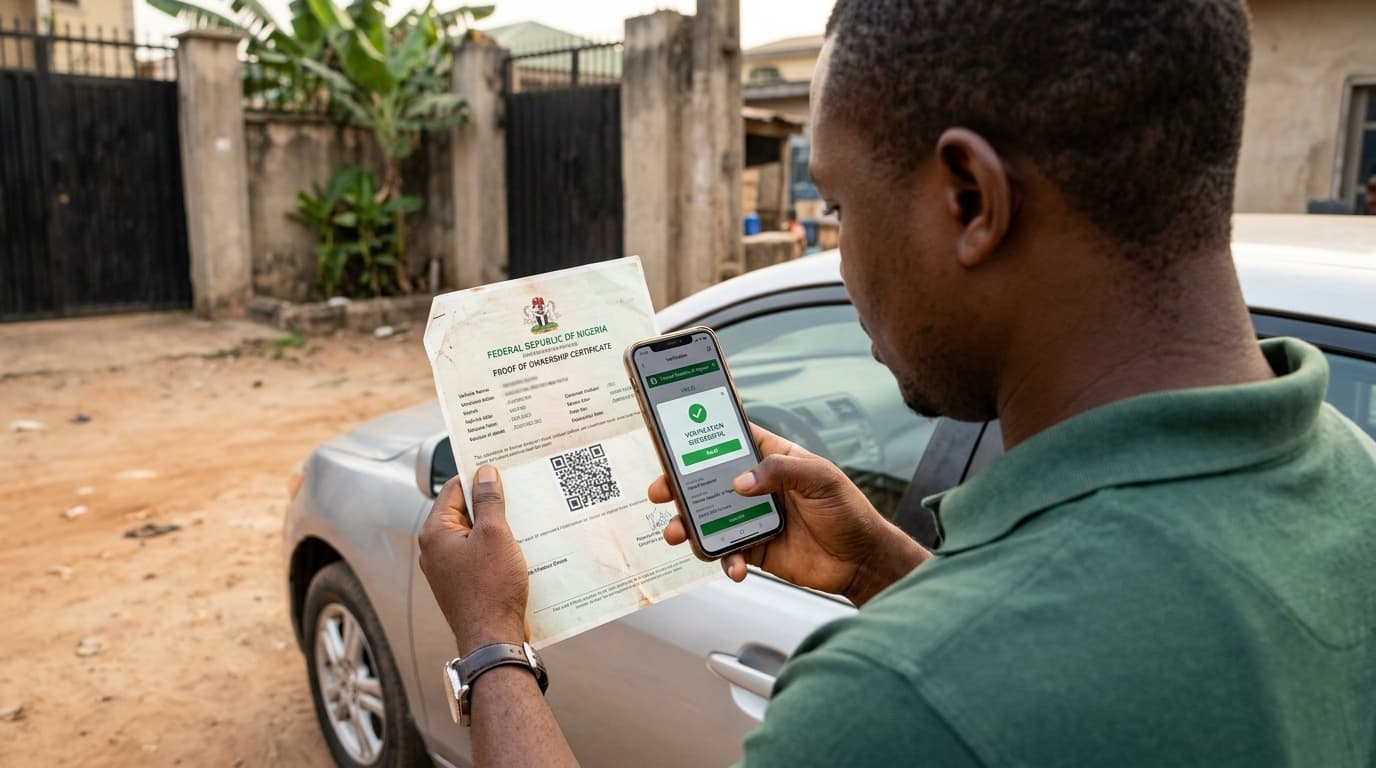
- Proof of Ownership Certificate (POC): This certificate names the owner and lists the car's details. The state licensing office prints it after registration and hands it over with the vehicle identification tag and the plate number. Lagos also issues an annual POC with the FRSC. At launch, officials said it does not replace other papers such as the driver's licence or the roadworthiness certificate, and it carried a ₦1,000 yearly fee.
- Vehicle registration certificate and plate number: These show that the FRSC register holds the car. Without them, officers may suspect that the car has no clear origin.
- Bill of sale or invoice: This paper records the sale from the seller to you. For a used car, guides list a bill of sale or Form C as the ownership proof.
- Customs papers (imported cars): These show that the car entered Nigeria legally and that someone paid the duty.
No single paper proves everything. A solid ownership story holds together across the certificate, the registration record, the sale paper, the customs record, and the car itself.
Skipping verification puts your money and your freedom at risk. Buyers who skip it may purchase a stolen car, inherit unpaid fines, or face legal action after the sale. Even a good-faith payment may not protect you. Buying a stolen vehicle can leave you with serious problems, whatever you paid the seller.
This list shows what you gain when you check properly:
- Protection from stolen cars: You catch cloned plates, altered chassis numbers, and forged papers before they cost you the car.
- Smooth registration: Registration offices ask for clear ownership proof. Weak papers stall the process.
- Insurance and resale: Insurers and future buyers look at the same records, so clean ownership keeps your car easy to insure and sell.
- Peace on the road: You show your papers at a checkpoint without fear.
Cloned plates also occur often, so a plate check alone does not finish the job. Always cross-check the plate with the chassis and engine numbers on the car and in the records.
The papers you ask for depend on the car's story. Use this table as your starting checklist for how to verify vehicle proof of ownership in nigeria:
| Car Type | Ownership Papers to Ask For | Extra Proof |
|---|---|---|
| Brand-new car | Dealer invoice, delivery note, and attestation letter | Motor Vehicle Duty Certificate, plus your driver's licence, passport photograph, and proof of address |
| Nigerian-used car | Original proof of ownership certificate, signed bill of sale, and previous registration documents | The seller's valid ID, and a police report that the car does not appear as stolen |
| Tokunbo or imported car | Customs clearance certificate and duty certificate | Matching VIN or chassis number, TIN, and certificate of entry |
Requirements shift across states, so confirm the exact list with your local motor vehicle administration agency. In every case, ask for originals, and match the name on the papers with the seller's ID.
Also Read: How Much to Clear a Car in Nigeria? Full Cost Breakdown
Follow these eight steps in order. Each one closes a different gap, so do not skip any.
Ask for the seller's valid ID, and compare the name with the one on the proof of ownership and the bill of sale. A mismatch needs a clear, documented explanation, such as a sale that the seller can prove. Without one, walk away.
Find the VIN, or chassis number, on the dashboard plate near the windscreen and on the door frame, then read the same number on every paper. Customs documents, the proof of ownership, and the vehicle licence all quote it, and every one must carry the same number. A scratched, repainted, or re-stamped number signals trouble.
Open the FRSC NVIS portal, enter the plate number, and submit. The result tells you whether the plate holds a valid record and which type of vehicle it belongs to. Compare that result with the car in front of you. One example message reads: "Number plate has been produced by FRSC and assigned to TOYOTA HIGHLANDER" with a date. If your seller shows a Corolla, you have a problem.
Portal results usually hide the owner's full personal details for privacy, so treat the check as a match test between plate and vehicle, not a name lookup.
The FRSC runs a Proof of Ownership Verification Platform that helps owners confirm their vehicle ownership. Ask the seller to show the record, and compare its details with the certificate in your hand. Also look for the registration date and the state of issue.
For any foreign-used car, run a customs check with the VIN. At Afrikars, we provide a free public VIN decoder where users can enter a VIN and retrieve information reported by the manufacturer. The next section explains the Customs Verification Management System in detail.
A fake insurance certificate often travels with fake ownership papers. You can verify a Nigerian motor insurance policy by dialing *\7292#** on your mobile phone or checking online through the NAICOM Portal. Confirm that the policy names the same car and the same owner.
A genuine seller should have no problem providing a police report, which confirms the car does not appear as stolen, among the documents for a change of ownership. To verify a Nigerian-used car during a change of ownership, you should check the vehicle via the Nigeria Police Central Motor Registry rather than relying on a physical paper police report.
If the car is already registered on the e-CMR portal, the seller can initiate the transfer directly from their profile, or you can complete the process at your state's motor licensing office (such as the MVAA in Lagos) to obtain a new Proof of Ownership Certificate.
Look at the chassis plate, the engine number, and the paint. Then hire an independent mechanic to inspect the car. Finally, get a written invoice that names the seller, the VIN, the price, and the refund terms. Pay only through a traceable method, and confirm that the account belongs to the seller.
Also Read: Cars for Sale in Nigeria | Prices, Deals & Buying Tips
When you plan how to verify vehicle proof of ownership in Nigeria for an imported car, one more layer of proof matters: customs. A seller can show a stamped receipt, yet forged receipts exist. Instead of trusting paper alone, check the record at the source.
The Nigeria Customs Service launched the Customs Verification Management System (CVMS) in November 2025. The platform lets individuals, importers, and dealers confirm a vehicle's authenticity, origin, and duty payment status with a VIN. Before, buyers relied on intermediaries, which caused delay and fraud. At launch, the verification fee stood at ₦15,000, payable with any local or international debit or credit card. The system confirms authenticity and produces a downloadable receipt with a QR code. Fees and web addresses can change, so confirm them on the official Customs site before you pay.
Follow this routine for every Tokunbo car:
- Get the VIN from the car itself, not only from the papers.
- Run the VIN through the CVMS and save the receipt.
- Match the result with the seller's papers. Duty paid on a different vehicle does not cover yours.
- Check the model year. Customs values imported cars through its VIN valuation system, not through your invoice, so a car sold with the wrong year can cost you at the port or at registration.
- Ask for the customs clearance papers and the duty certificate. You need them to register the car.
If you import the car yourself, the first owner on paper starts at the US title. The title shows the chain of ownership from the US seller to you, so keep it safe. Afrikars customers receive it at delivery together with the customs papers.
Watch for these warning signs while you work through how to verify vehicle proof of ownership in nigeria:
- The seller shows only photocopies and refuses to produce originals.
- The name on the papers differs from the seller's ID, with no written explanation.
- The VIN or chassis number looks scratched, repainted, or different from the paperwork.
- The plate returns no record, or it shows another make and model on the NVIS portal.
- The customs check fails, or the duty papers carry a different VIN.
- The insurance certificate fails a verification check.
- The seller changes the story about where the car came from.
- The price sits far below similar cars, and the seller pushes you to pay fast.
- The seller asks you to pay a personal account that does not match the seller's name.
One scam deserves its own mention: the cloned VIN. Scammers copy the VIN of a legally registered car and fit it to a stolen or salvaged one, so the papers look right at first glance. Physical checks, record checks, and an independent inspection together expose most clones.
One warning sign does not always prove fraud. Still, resolve every concern before you send money.
Knowing how to verify vehicle proof of ownership in Nigeria protects you before you pay. A proper transfer protects you afterwards. Until you change the ownership, the previous owner still appears in the records.
You need: the Change of Ownership form from the state motor vehicle administration agency, the seller's signed bill of sale, the original proof of ownership certificate, your NIN, a valid ID, and a police report confirming that the car does not appear as stolen. You then pay the change-of-ownership fee at the bank and register the car in your name. Requirements vary by state, so check your local office first.
Follow these tips for a clean handover:
- Transfer fast. Do not leave the car in the seller's name for months.
- Choose "change of ownership," not "fresh registration." The wrong choice triggers NVIS mismatches.
- Update your insurance. Make sure the policy names you and the same chassis number.
- Keep every receipt. Store the bill of sale, bank receipts, and certificates together.
- Verify your own plate. After registration, check it on the NVIS portal to confirm that it matches your car.
Also Read: VIN Decoder: How to Decode a Vehicle VIN Number Easily
- Trusting photocopies: Forgers copy stamps and signatures well, so ask for originals.
- Checking only the plate: Cloned plates exist, so match the chassis and engine numbers too.
- Skipping the customs check: A foreign-used car without verified duty status can block your registration.
- Believing the seller's phone: Look up official portals yourself, and never use a link that the seller sends.
- Paying a deposit first: Verify first, pay later.
- Ignoring the name mismatch: A name that differs from the ID needs written proof.
- Forgetting the transfer: An untransferred car leaves you exposed on every future check.
- Skipping the inspection: Papers cannot prove mechanical condition.
A mismatch during how to verify vehicle proof of ownership in Nigeria does not always mean theft. Sometimes a paperwork slip causes it. First, two registrations may exist for the same plate, and the portal accepts only one of them, so the other owner sees a different vehicle. Second, the original owner may have sold the car together with its plate number.
A new owner registers a used car as a fresh registration instead of a change of ownership, and the portal rejects the duplicate details. The fix: visit the Motor Licensing Authority and ask them to push the record to the FRSC as a change of ownership.
Use this plan when the check fails:
- Pause the payment. Do not hand over money while questions remain.
- Ask the seller to fix the record at the licensing office, and wait for proof.
- Cross-check the chassis and engine numbers against customs or inspection records when the plate returns no result.
- Report suspected theft to the FRSC or the police.
- Walk away if the seller cannot explain the gap clearly and quickly.
Learning how to verify vehicle proof of ownership in Nigeria protects you at home. Importing a car adds a second challenge: clean papers from the US seller to your driveway. Afrikars removes much of that stress. You can browse US dealer stock and auction cars, fund your budget, and we buy the car on your behalf. Then we move it to the port, ship it, clear it through Nigerian customs, and deliver it.
This list shows what you receive and what protects you along the way:
- Title in your name: Title passes from the seller to you, and you receive it at delivery.
- Customs papers: We act as the importer of record and hold our own customs licence, so we clear your car and pay the duties. You receive the customs clearance papers and proof of duty paid.
- VIN Check: Our VIN Check costs ₦8,500 per report, and anyone can buy one with a card, no account needed. Verified customers receive 3 free checks at the point of purchase.
- Checked listings: On the marketplace, you review the dealer's walkthrough video and the vehicle history report before you authorise a purchase, and our team checks both first.
- Escrow protection: A licensed partner holds your funds and releases them in stages as each step clears.
- Registration help: Registration and plates come as an optional service that you add when you request the car. Otherwise, you register the car yourself with the title and customs papers we hand over.
- Live tracking: You follow your car in the app from the US port to your door.
After delivery, apply the same routine for how to verify vehicle proof of ownership in Nigeria from this guide. Check your own plate on the NVIS portal, and keep your documents safe. A few honest notes apply too. Afrikars does not guarantee delivery times, and auction cars sell "as is," so you accept their condition once you authorise the purchase. Even with all our checks, run your own verification and hire an independent inspector when you can.
Want a specific make and model? Ask our Concierge team to source it, estimate your total with the cost calculator, or contact us with your questions.
Also Read: Copart Nigeria: How to Buy Cars From Copart USA Safely
Match the seller's ID with the papers, compare the VIN on the car with every document, verify the plate on the FRSC NVIS portal, check customs status for imported cars, verify the insurance, and inspect the car. Then transfer the ownership into your name.
The FRSC portal confirms whether a plate holds a valid record and which type of vehicle it belongs to. It usually hides the owner's full personal details for privacy . Treat the result as a match test between the plate and the vehicle.
Run the car's VIN through the Customs Verification Management System. At launch, the fee stood at ₦15,000 per check by card, and the system gives a receipt with a QR code. Confirm the current fee on the official Customs site.
Pause the payment. Duplicate registrations, or a plate sold along with the car, can cause the mismatch, and the licensing office can fix the record as a change of ownership. If the seller cannot clear it up, walk away.
Yes, you can decode a VIN for free using our free online VIN decoder tool. Kindly note that the Vin Decoder is free only after creating an account and completing the KYC onboarding requirements. You can click here, follow every other step to successfully decode your VIN for free.
Yes. Until you transfer it, the previous owner still appears in the records. Use the change-of-ownership route, not a fresh registration, so the NVIS record stays clean.
You receive the title, the customs clearance papers, and proof of duty paid at delivery. Registration and plates come as an optional service, and you can add them when you request the car.
- Legit.ng, how to check if a vehicle was stolen
- News Central TV, FRSC recovers stolen car in Anambra
- FRSC, service charter and Proof of Ownership Verification Platform
- Arise, annual proof of ownership certificate
- BusinessDay, seven must-have car documents
- BusinessDay, genuine third-party insurance
- Awajis, vehicle registration in Nigeria and free VIN check guide
- Nigerian Queries, register a car
- Kashgain, FRSC registration documents
- Loconav, identify a number plate owner
- Alibaba Car Interior, verify vehicle ownership and verify plate number
- Primetime Reporters, NVIS plate mismatches
- Sweet Crude Reports, CVMS launch and stakeholder briefing
- The Guardian Nigeria, CVMS verification fee
- Eat Healthy 365, avoid a car scam in Nigeria
- AFRIKARS FAQs