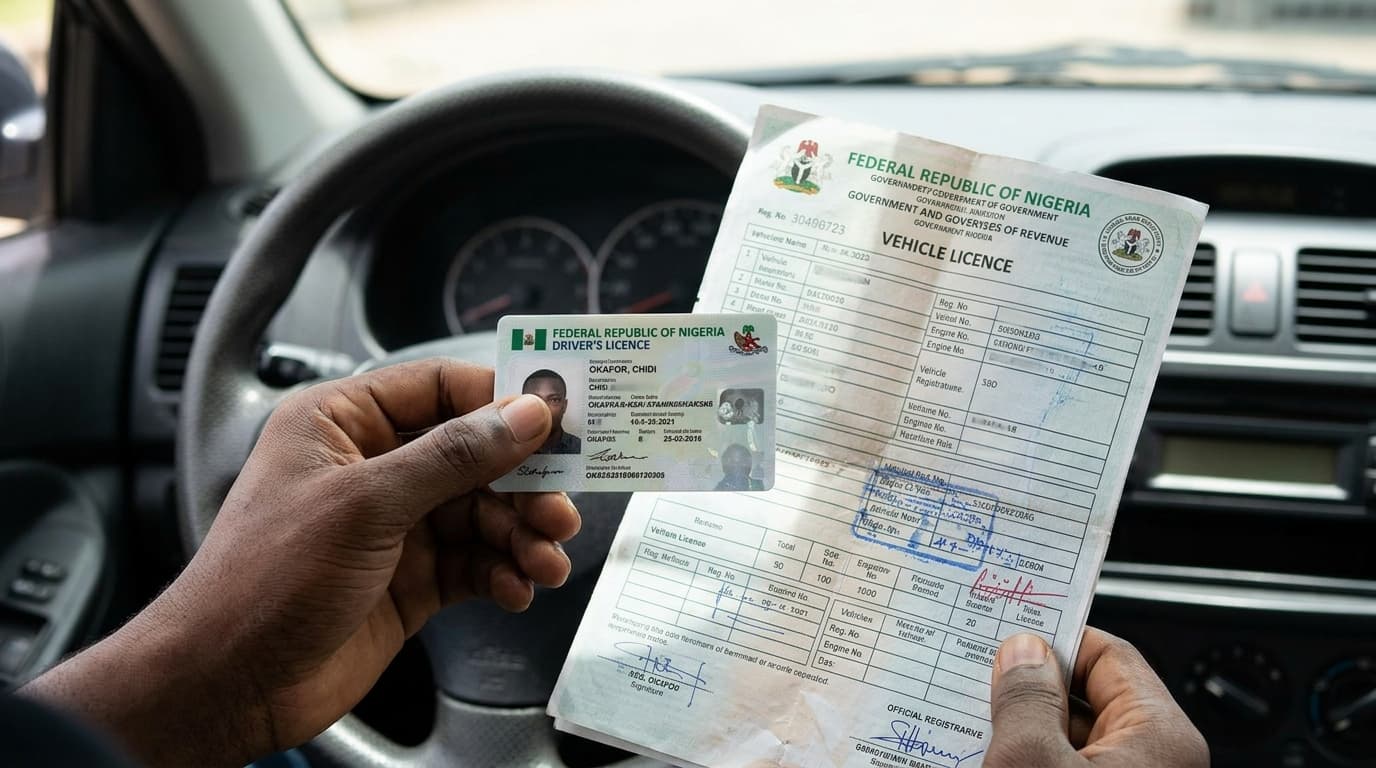
You buy a car, pay a fortune, and drive off happy. Then a checkpoint stops you, and an officer asks for your papers. Do you know what to show? Many drivers freeze at that moment. Some carry only a driver’s licence, while others hold expired insurance or a photocopy that nobody trusts. A missing or expired document can bring penalties, and officers may even impound the vehicle.
So, what are the papers required for a car in Nigeria? The answer shifts a little with the type of car. A brand-new car, a Nigerian-used car, and a Tokunbo import each need different proof. Fake papers also circulate widely. In 2026, the Federal Road Safety Corps (FRSC) recovered a stolen Toyota Corolla in Nnewi after its chassis number showed inconsistencies during a routine check on the National Vehicle Identification Scheme (NVIS) portal.
This guide lists every document, explains what each one proves, and shows you how to verify papers before you pay. You will also see how AFRIKARS helps buyers import cars with a clean title and customs documents. Read on, and protect your money and your car.
Also Read: Cars for Sale in Nigeria | Prices, Deals & Buying Tips · AFRIKARS
Before the details, this table gives you the full picture. Each document answers a different question, so you need all of them.
| Document | What It Proves | Who Handles It |
|---|---|---|
| Driver’s licence | You may legally drive | FRSC |
| Vehicle registration certificate and plate number | The car sits on the national register | State motor licensing office and FRSC |
| Proof of ownership certificate | The car belongs to you | State licensing office with FRSC |
| Vehicle licence | You paid the road tax | State internal revenue board |
| Certificate of roadworthiness | The car passed a safety inspection | Vehicle Inspection Office (VIO) |
| Motor insurance certificate | You hold at least third-party cover | Licensed insurer |
| Customs duty papers (imported cars) | The car entered Nigeria legally | Nigeria Customs Service |
Some states add their own rules and fees, so check with your local licensing office. Still, these seven items form the core of what are the papers required for car in Nigeria in almost every state.
Officers usually ask for your driver’s licence first. Driving with an expired or missing driver's licence in Nigeria attracts a fine of ₦10,000 as an official FRSC Offences & Penalties traffic violation. Renew early, and carry the original.
In Nigeria, the Vehicle Registration Certificate issued by the Federal Road Safety Corps (FRSC) or the State Motor Vehicle Administration is the primary proof of legal ownership and proper registration.
Failing to present genuine documents or properly display both license plates can lead to vehicle impoundment, heavy fines, or arrest under suspicion of vehicle theft.
Also Read: Used Cars for Sale in Nigeria | Prices & Buying Guide · AFRIKARS
This certificate names the legal owner and lists the car’s details. Lagos introduced an annual Proof of Ownership Certificate with the FRSC. Officials said it does not replace the driver’s licence, roadworthiness certificate, or other papers. It also builds a database that supports the NVIS register. At launch, it carried an annual fee of ₦1,000. Fees change, so confirm the current amount with your licensing office.
The vehicle licence shows that you paid the road tax. In Lagos, owners renew it every year through the State Board of Internal Revenue. Set a reminder, because an expired licence invites trouble.
This certificate proves that your car passed an inspection of its brakes, lights, and emissions. Lagos runs a computerised inspection for it. Display the validity tag as required, and never move a tag to another vehicle.
Third-party motor insurance holds legal force in Nigeria. The Nigeria Police Force began nationwide enforcement on 1 February 2025. The National Insurance Commission (NAICOM) enforces third-party motor insurance as the mandatory legal minimum for all vehicles on Nigerian roads under Section 68 of the Insurance Act 2003, while comprehensive insurance remains optional. Private car owners pay a premium of ₦15,000 per year for third-party cover, and the policy gives a ₦3 million limit for third-party property damage.
Buy only from insurers that NAICOM licenses. Fake certificates circulate at motor parks and licensing offices, so verify your policy. NAICOM officials say you can check a policy with the \*7292# code.
In Lagos, the allocation paper often comes with the proof of ownership or registration papers. It verifies the allocation of your plate number, chassis, and engine, and it helps show that you acquired the car legally.
- Tinted glass permit: Tinted windows need a permit from the Nigeria Police Force.
- Safety items: Keep a C-caution sign, a fire extinguisher, and a spare tyre in the car.
 Also Read: VIN Decoder: How to Decode a Vehicle VIN Number Easily · AFRIKARS
A new car comes with less history, so the paperwork focuses on the dealer and the sale. Ask the dealer for these items:
- Car invoice: It records the price and car details.
- Delivery note: It confirms that the dealer handed the car to you.
- Attestation letter: The dealer states that it sold you the car.
- Motor Vehicle Duty Certificate: It shows the duty status.
You also bring your own papers: a driver’s licence, an auto insurance policy, a passport photograph, and proof of address such as a utility bill. Most dealers help with registration, but you should still read each document before you sign.
Nigerian-used cars carry the longest paper trail, so check every page. Ask the seller for these papers:
- The original proof of ownership certificate
- The previous registration documents
- A signed bill of sale
- The valid insurance and roadworthiness certificates
- The seller’s valid ID
Then change the ownership into your name. One published guide lists the steps like this: collect a Change of Ownership form from the state motor vehicle administration agency, attach the signed bill of sale, the original proof of ownership, your NIN, and a valid ID, add a police report that confirms the car does not appear as stolen, pay the fee at the bank, and register the car in your name. Requirements differ across states, so confirm the list with your local office.
Do not skip the change of ownership. Some new owners register a used car as a fresh registration instead. The NVIS portal then rejects the duplicate details, and later checks may show another car’s information under your plate. Fix this early, because it can delay renewals and resale.
Also Read: Cost of Clearing a Car in Nigeria: Fees & Import Charges · AFRIKARS
Imported cars need proof that they entered Nigeria legally. Without it, you cannot register the car in most states. Gather these papers:
- Customs clearance certificate: It proves that the car passed through customs legally.
- Duty certificate: It shows the customs duty you paid.
- Vehicle Identification Number (VIN) or chassis number: It must match every document.
- Tax Identification Number (TIN): Many registration offices ask for it.
- Certificate of entry: Customs issues it for approved imports.
Customs officials have explained the link in simple terms: when you import legally, you receive a duty certificate, and you use it to register the car. Kano State’s registration guidelines also list customs documents for imported vehicles and previous registration papers for used ones.
Registration turns your purchase documents into the papers that officers check. The steps below follow a typical state process.
- Gather your documents. Collect proof of ownership, your NIN slip, a valid ID, customs papers for imports, your VIN or chassis number, and your engine number.
- Buy insurance. Get a valid certificate from a NAICOM-licensed insurer, because registration offices ask for the policy details.
- Submit your application. Complete the Allocation of Plate Number form at the state motor vehicle administration agency, or start the process online on the FRSC NVIS portal at nvis.frsc.gov.ng.
- Pay the fees. Plate costs differ by state. One guide puts a private plate in Lagos at ₦30,000 to ₦40,000, while Kano lists a standard private plate at ₦30,000.
- Pass the inspection. A Vehicle Inspection Officer checks the car physically. You then receive your roadworthiness certificate, proof of ownership certificate, vehicle identification tag, and plate number.
- Verify your plate. Check it on the NVIS portal to confirm that it matches your car.
Processing times vary. One guide says Lagos AutoReg and the FRSC NVIS portal can shorten registration to about 10 to 14 days. Imported cars may take longer when customs verification applies.
Never trust a paper because it looks official. Forgers copy stamps, logos, and signatures well. Use these checks instead:
- Match the numbers. Compare the VIN, chassis number, and engine number on the car with every document. A mismatch signals a serious problem.
- Check the plate on NVIS. The portal lets you verify a number plate, and it pulls data from several agencies.
- Verify the insurance. Dial \*7292# or use NAICOM’s channels to confirm that the policy exists.
- Confirm the customs status. For imported cars, ask for the duty certificate and verify it through official Customs channels, not through the seller’s word alone.
- Inspect the car physically. Look at the chassis plate, and check for altered paint or damaged identification marks.
- Hire an independent mechanic. Papers cannot prove mechanical condition, so a proper inspection still matters.
- Run a VIN history check. Our VIN Check helps you review a car’s background before you commit.
The Nnewi case shows why these steps matter. Investigators found that someone had changed the stolen Corolla’s colour from red to grey and fitted an unassigned plate. The NVIS check still exposed the car, and officers arrested the agent and the applicant.
Watch for these warning signs:
- The seller refuses to show original documents.
- The names on the papers do not match the seller’s ID.
- The VIN or chassis number looks altered, scratched, or different from the paperwork.
- The plate number returns no record, or it shows another car on NVIS.
- The insurance certificate fails a verification check.
- The seller pushes you to pay before you see the papers.
- The price sits far below the market rate with no clear reason.
One warning sign does not always prove fraud. Still, resolve every concern before you send money.
Also Read: Car Dealers in Nigeria | How to Find a Trusted Dealer · AFRIKARS
Costs shift by state, so treat the figures below as a guide:
| Item | Reported Cost |
|---|---|
| Third-party motor insurance (private car) | ₦15,000 per year |
| Private number plate, Lagos | ₦30,000 – ₦40,000 |
| Standard private plate, Kano | ₦30,000 |
| Lagos proof of ownership (at launch) | ₦1,000 per year |
Budget for the vehicle licence, roadworthiness test, and agent fees too. Always pay through official channels and keep every receipt.
- Delaying registration: Driving an unregistered car invites fines and impoundment.
- Letting papers expire: Insurance, vehicle licence, and roadworthiness all need renewal.
- Skipping change of ownership: This mistake causes NVIS mismatches later.
- Trusting photocopies: Always ask for originals, and keep your own originals safe.
- Buying cheap insurance from strangers: Fake certificates look real until a verification check fails.
- Ignoring customs papers on a Tokunbo: No duty certificate usually means no registration.
Keep your documents safe but easy to reach. Laminate copies, and store them in a waterproof folder. Photograph every document and save the files in cloud storage. Then set calendar reminders for each expiry date. Finally, keep the originals of your proof of ownership and customs papers at home, and carry only what the law asks you to show.
Paperwork causes the biggest headaches in car imports. AFRIKARS removes much of that stress. You browse US dealer stock and auction cars, fund your budget, and we buy the car on your behalf. We then move it to the port, ship it, clear it through Nigerian customs, and deliver it to you.
AFRIKARS acts as the importer of record and holds its own customs licence, so you never deal with the port or a separate clearing agent. At delivery, you receive the title (transferred from the seller to you), the customs clearance papers, and proof of duty paid. Registration and plates stay optional, and you can add them when you request the car. Otherwise, you register the car yourself with the papers we hand over.
Several features protect you along the way:
- Landed price upfront: Every listing shows an estimated landed cost, so you see the full price before you commit.
- Escrow protection: A licensed partner holds your funds and releases them in stages.
- Live tracking: You follow your car in the app from the US port to your door.
- History checks: Our team reviews marketplace listings, and you can run any VIN through our VIN Check.
Keep one honest note in mind: AFRIKARS does not guarantee delivery times, and regulation changes can raise landed costs in rare cases. Even so, our process gives you a clear paper trail from the US seller to your driveway.
Want a specific make and model? Ask our Concierge team to source it, estimate your total with the cost calculator, or contact us with questions.
Also Read: How Much to Clear a Car in Nigeria? Full Cost Breakdown · AFRIKARS
Every car owner needs a driver’s licence, vehicle registration certificate, proof of ownership certificate, vehicle licence, roadworthiness certificate, and valid motor insurance. Imported cars also need customs clearance papers and a duty certificate.
Bring the dealer’s invoice, delivery note, and attestation letter, plus the Motor Vehicle Duty Certificate, your driver’s licence, insurance policy, passport photograph, and proof of address. Registration offices may also ask for your NIN.
One published guide lists a police report confirming the car does not appear as stolen among the change-of-ownership documents. Rules differ by state, so confirm the list with your local motor vehicle office.
Yes. The law requires at least third-party motor insurance, and police began nationwide enforcement on 1 February 2025. Private owners pay ₦15,000 per year for the policy.
Ask for the customs clearance certificate and the duty certificate. Verify both through official Customs channels, and match the VIN or chassis number with the car.
Use the FRSC NVIS portal to verify the plate, and compare the result with the car’s chassis and engine numbers. If the plate shows another car’s details or returns no record, pause the purchase.
You receive the title, the customs clearance papers, and proof of duty paid at delivery. Registration and plates come as an optional service, and you can add them when you request the car.
Sources:
- BusinessDay, seven must-have car documents
- BusinessDay, documents for Lagos motorists
- BusinessDay, genuine third-party insurance
- Arise, annual proof of ownership certificate
- ICIR, third-party insurance enforcement
- TheCable, NAICOM on third-party insurance
- ThisDay, enforcing third-party motor insurance
- Awajis, vehicle registration in Nigeria
- Nigerian Queries, register a car
- Kano State Government, registration guidelines
- Kashgain, FRSC registration documents
- Shipping Position, Customs and FRSC
- Primetime Reporters, NVIS plate mismatches
- Open Exam Prep, registration and roadworthiness
- Gazette, FRSC stolen car recovery and News Central TV
- Nigeria Trade Information Portal, automobiles
- AFRIKARS FAQs